How to Choose Between DMR, TETRA, and PoC Radios: A Comparison Guide
If you’re researching business radios, you’ll quickly come across three acronyms: DMR, TETRA and PoC.
They all enable teams to communicate instantly, but they’re designed for very different environments and operational needs.
So, which is right for your business: DMR, TETRA or PoC?
In simple terms, DMR is often suited to teams working on one site or within a defined area; PoC can work well for geographically dispersed teams using cellular networks; while TETRA is designed for more complex, mission-critical environments where resilience and security are paramount.
But there’s more to consider than coverage alone. Cost, infrastructure, reliability, functionality and how your organisation might change all matter too.
This guide compares the three technologies to help you understand which could be the best fit for your organisation.
What Do DMR, TETRA and PoC Actually Mean?
DMR (Digital Mobile Radio)
DMR is a widely used professional two-way radio technology for business use. Unlike mobile phones, DMR radios operate on dedicated radio frequencies, giving organisations reliable, instant communication without relying on the public mobile network.
They’re commonly used in:
- Retail
- Manufacturing
- Warehousing
- Construction
- Education
- Hospitality
- Facilities Management
- Security
- Events
TETRA (Terrestrial Trunked Radio)
TETRA is designed for environments where communications are genuinely mission critical. It offers advanced security, resilience, sophisticated group calling and the ability to support large numbers of users simultaneously.
You’ll typically find TETRA being used by:
- Emergency services
- Airports
- Rail operators
- Utilities
- Critical infrastructure providers
- Large transport hubs
These are organisations where communication isn’t simply important; it is essential.
The Critical Communications Association (TCCA) highlights the importance of resilient, secure communications infrastructure in supporting organisations delivering critical services. Its paper on the physical security of telecommunications infrastructure used for critical communication services is a useful reference for organisations considering resilience requirements.
PoC (Push-to-Talk over Cellular)
PoC works differently. Instead of using dedicated radio frequencies, it uses existing 4G, 5G and Wi-Fi networks to deliver instant voice communication.
That means users can communicate across towns, cities or even the whole country, provided they have suitable network coverage.
PoC is increasingly relevant for:
- National retailers
- Housing associations
- Facilities Management providers
- Field engineers
- Mobile security teams
- Logistics businesses
Many PoC platforms can also support GPS tracking, messaging, image sharing and dispatch software, making them a useful choice for dispersed workforces.
DMR vs TETRA vs PoC: What’s the Difference?
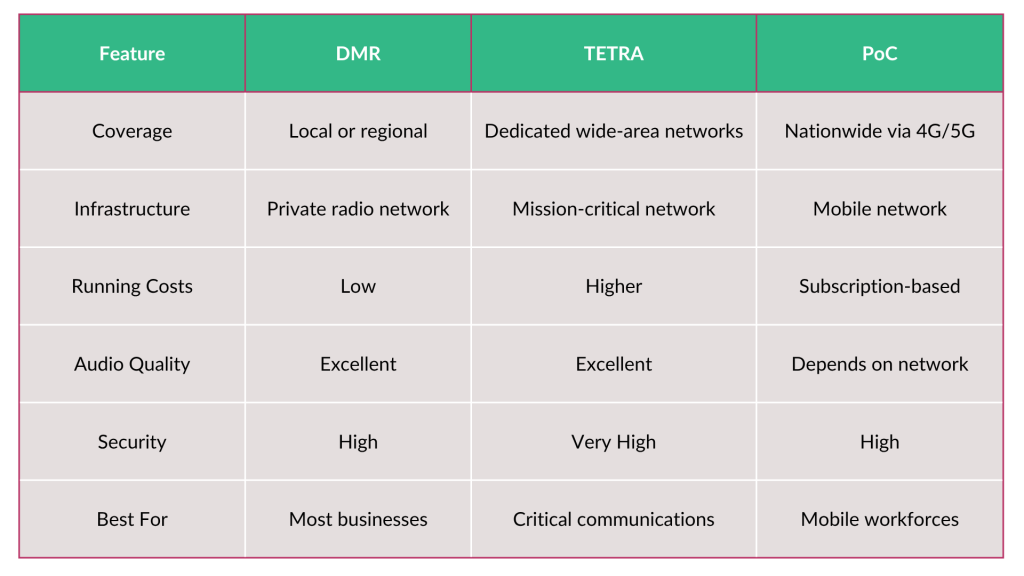
Which Radio System Is Right for Your Business?
Choosing the right technology starts with understanding how your teams work—not simply comparing specifications.
Choose DMR if…
Your teams mainly work on one site or across a local area.
Your teams mainly work on one site or across a local area. DMR solutions can be a good fit for warehouses, schools, hotels, factories, shopping centres and event venues where instant, reliable communication is important.
DMR can offer:
- Excellent voice quality
- Dedicated communications
- Low ongoing costs
- Fast response times
- Reliable performance
For most organisations, DMR is the practical choice.
Choose TETRA if…
Your organisation operates in an environment where communication failure could create serious operational or safety consequences. TETRA is designed for complex operations where resilience, security and operational continuity are paramount.
It is particularly suited to:
- Critical infrastructure
- Airports
- Utilities
- Rail
- Emergency response
- Large-scale command environments
Choose PoC if…
Your workforce is constantly on the move. If your teams travel between sites, operate nationally or spend much of their day on the road, PoC can offer significant advantages. Because it uses cellular networks, users don’t need to stay within the coverage of a traditional radio system.
It is particularly well suited to:
- Area managers
- Field engineers
- National retail estates
- Housing officers
- Mobile security teams
Which Radio System Is Right for You?
If you’re still not sure, this simple decision path can help narrow the options:
Do your teams mainly work on one site? If yes, ask whether you need instant, reliable communication that doesn’t rely on mobile signal. If yes, DMR could be a good fit.
Do your teams work across multiple locations or travel nationally? If yes, and they usually have reliable 4G or 5G coverage, PoC could be a good fit.
Would losing communications create a serious operational or safety risk? If yes, TETRA may be worth considering.
Still unsure? That’s exactly what we’re here for.
What Questions Should You Ask Before Choosing a Business Radio System?
Are they in one building, on one site, across multiple locations or nationwide? Coverage requirements are often one of the biggest deciding factors.
Is it inconvenient, or could it stop operations or create a safety risk? The answer will help determine how much priority you need to give resilience.
Modern communication systems can also provide GPS tracking, lone worker protection, emergency alerts, messaging, image sharing and, depending on the wider solution, integration with other technologies. Thinking about future requirements now could reduce the need to replace or reconfigure your system later.
Don’t just compare handset prices. Consider infrastructure, installation, licensing, subscriptions, maintenance, batteries, accessories and ongoing support. The cheapest option upfront isn’t always the most cost-effective over the life of the system.
Choosing the Right Partner Matters Too
The right radio system is only part of the equation. Whether you’re investing in DMR, TETRA or PoC, success comes from choosing a solution that’s designed around how your teams actually work – not simply what’s newest or most expensive.
At 2826, we take a consultative approach, getting to know your organisation before recommending a solution that genuinely fits your needs. It’s an approach that has helped us build long-term relationships with customers across retail, education, healthcare, hospitality, manufacturing, security, events and critical infrastructure.
Whether you need a straightforward DMR system, a resilient TETRA network or a nationwide PoC solution, our experienced team is here to help you understand the options and make an informed decision.
Contact one of our experts today
T: 0845 2200200